In September 1983, trucks from Atari drove into a landfill in Alamogordo, New Mexico, and dumped hundreds of thousands of unsold cartridges, including copies of E.T. the Extra-Terrestrial, often called the worst game ever made. For years people thought the story was an urban legend. In 2014 a documentary crew dug up the site and found the cartridges, still there in the sand.
The crash
By 1983 the American market was flooded with consoles and cheap, rushed games. Shoppers couldn't tell good from bad, so they stopped buying. Revenues fell by about 97% in two years, and many shops treated video games as a dead fad.
Meanwhile, in Japan
On July 15, 1983, the same summer America's market collapsed, Nintendo launched the Family Computer, or Famicom, in Japan. It was cheap, red and white, and had a cross-shaped D-pad borrowed from Nintendo's Game & Watch handhelds. After a slow start caused by a faulty chip and a recall, it became the console in Japanese homes.
Sneaking back into America
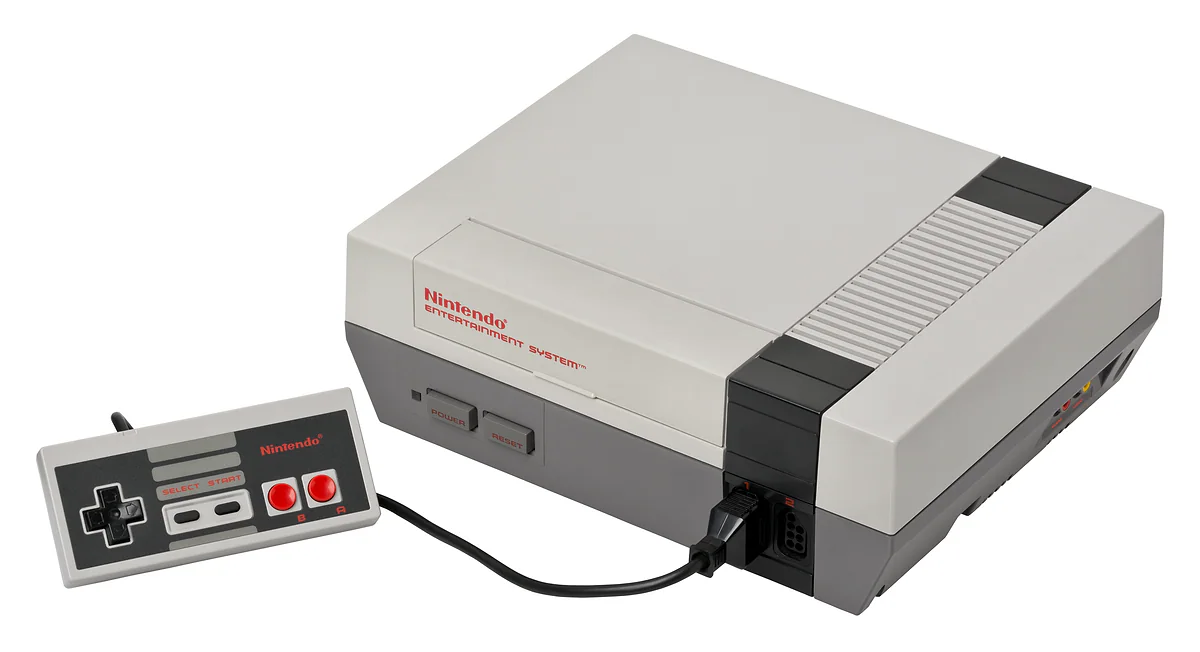
Nintendo knew American shops didn't want a "video game". So when it launched in New York in October 1985, it sold the Nintendo Entertainment System as a toy. It looked like a VCR, and it came with R.O.B., a plastic robot that could play along with a couple of games. Few people used R.O.B. for long, but he got the NES onto toy shop shelves. Nintendo also added a Seal of Quality and strict rules for publishers, to stop the flood of junk games that had killed Atari.
World 1-1
The real reason the NES worked was Super Mario Bros. (September 1985), designed by Shigeru Miyamoto and Takashi Tezuka. Its first level, World 1-1, is still studied as a perfect tutorial with no words. The first Goomba teaches you to jump, the first block teaches you to hit things from below, and a mushroom that slides toward you teaches you that power-ups are good.
The legacy
The Famicom and NES rebuilt home gaming from scratch. They brought in the third-party licensing model that consoles still use, and they made Mario the face of the medium. Every console war since, Sony versus Nintendo versus Microsoft, is fought on ground Nintendo cleared in 1985. Continue with Tetris, the puzzle that made the Game Boy.